|
Fremont Hotel
The history of the Fremont Hotel is America's story. It's the story of war, immigration and the western migration of settlers. My great great grandfather John Miller, built the Fremont Hotel in 1866. It was an interesting time in our history. Immigrants like John came to America to escape the unending wars of Europe.
John came to New York only to find America on the verge of civil war. So he sold his land, bought a stallion, came to Iowa, sold his stallion and bought the land that I spent my early childhood roaming around on. At that time, Iowa was the place to be if you wanted to avoid war. The Civil War started in 1861 a thousand miles to the East and never did cross over the Iowa border.
Iowa escaped the worst of the Indian wars with only one massacre. The great Sioux war had already been pushed out west of the Platte river and would begin in earnest with the Sand Creek massacre of 1864 and reach a climax with Custer's last stand against Crazy Horse at the battle of the Little Bighorn in 1876.
The immigrants who would stop for a bite to eat at the Fremont Hotel were likely taking part in the great Black Hills gold rush of 1874. So John Miller must have heard a lot of their stories and have been glad to live safely in Iowa, attending to the needs of travelers and their oxen.
|
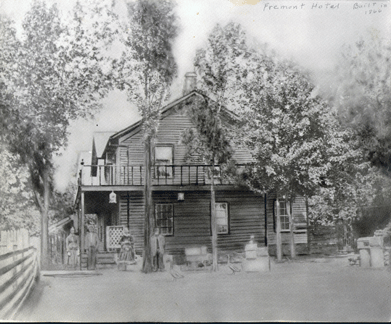
This is a picture of the Fremont Hotel taken circa the late 1870's. The people in the picture are believed to be John Miller and his wife, Mary, in the center with their son, George, standing to the left. The woman on the far left is either George's soon to be wife, Mary, or one of his sisters.
|
|
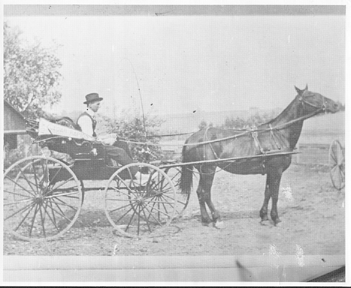
This is a picture of a mail delivery wagon of the 1800s.
|
The Fremont Hotel owes it's beginning to the American Constitution and its directive to establish "post roads". The Post Office had the responsibility of awarding contracts to stage coach companies to carry mail and the Western Stage Company had won that contract for Iowa. The State of Iowa established the Toledo Road between Cedar Rapids and Toledo in 1854, the Fremont Hotel would become the only stage coach stop between these two towns.
I say towns because John Miller would later claim that Cedar Rapids was too small to even have a market for his grain. He would spend a week taking a load of grain to Iowa City and bringing back supplies. Mail delivery and transportation determined where towns would sprout up. While the Fremont Hotel started as a stagecoach stop Atkins owes it's existence to the railroad that would come through and in 1881 the Milwaukee House Hotel was built to house the men building the railroad.
So John had the Atkins hotel market all to himself for 15 years. Mail delivery was an important part of all stage coach stops and even my grandfather Charles would later deliver mail by horse and buggy. Years later, I would be thrilled at the sight of watching the trains pass off the mail bags to the train depot in Atkins without stopping. There was a hook at the edge of the tracks and the train engineer would hang the mail bag out the train window and the bag would catch that hook and Atkins had its mail.
|
|
I spent the first seven years of my life in the former Fremont Hotel. My grandfather Charles was born there and lived his whole life there. Atkins started as a village two miles North of the Fremont Hotel and was called Haag. But the German settlers didn't appreciate the Dutch name and started to call it Poker Flat. This name came about because of a weekend ritual at a tavern of taking a poker out of the fire and putting it into a glass of beer. This made the beer flat, or Poker Flat!
The agent for the Milwaukee railroad founded the town of Atkins in 1882, calling it by his last name. The first house in the new town was built for the section foreman. As a boy, I loved exploring what remained of the Milwaukee round house and train yard with its bunkhouse. It was still in use in the 1960's and there was even a diner out there to feed the men who stayed in the bunkhouse.
The trains brought an end to stagecoaches. The Toledo Road was replaced first by the Lincoln Highway in 1927 and later called Highway 30. So the Fremont Hotel stopped feeding hungry travelers but food was still grown locally and farm wives took an active part in raising crops and livestock along with canning, butchering and cooking.
|
|
|

My grandmother's recipe books and old Zenith radio.
|
Creative memories are the stuff that family legends are made of. And one of those legends has my grandmother Ruth as a young girl of about 12 years old being alone at the Fremont Hotel with her mother out in the fields and the rest of the family gone. Mud roads were legendary back then and thirty oxen with their drivers stopped by because of the mud and my grandmother Ruth took care of the oxen and fed the travelers all by herself! It made for a great story and the reporter who interviewed my grandfather believed every word of it!
While my grandmother never cooked for guests of the Fremont Hotel, she did use the kitchen. Cooking was a lot different back then. Behind my grandfathers house was a small building we called the summer kitchen. Now put yourself in the middle of a hot summer, no air conditioning and a dining room full of hungry travelers. And all you have to cook with is a wood burning stove. Can you imagine how hot that house would have been in the summer? Well in the summer they would cook in the summer kitchen and bring the food into the house.
My grandmother Ruth loved to cook and while I never got to meet her while she was alive, she did leave me with part of her legacy in the form of three journals and a radio. Radios were an important connection with the outside world when you spend your life as a farm wife in the 1930's. And Grandma Ruth would sit by the Zenith radio and record recipes in her journals that other farm wives would send into the radio program. As I looked through her hand written recipes, it struck me that they didn't include any directions for time and temperature.
And that makes sense when you cook with a wood burning stove. A good cook knows how hot the fire is and when the food is done. All farm wives cooked with wood burning stoves back then. Some of the recipes even called for open fires as the butchering took place outside.
|


